Launch offer — valid today only

📄 Digital book in PDF · read it on your phone or print it

Texas Landscape Irrigation License Exam, in Drawings One Topic on Every Page

Built on Texas TCEQ rules. Pressure, head-to-head coverage, precipitation rate, backflow devices, valve wiring and the dead-zone check: each one drawn on its own page, with the numbers you need in a box beside it. 63 illustrated pages.

START STUDYING THIS WAY

🔒 Secure checkout · PDF by email · 30-day guarantee

Every topic, its own pageEach part of the system drawn, with the explanation right beside it
63 illustrated pages8 parts, from the point of connection to the last review before the exam
Up-to-date sourcesTCEQ rules (30 TAC Ch. 344), Texas Occupations Code Ch. 1903 and IA technician exam content areas
PDF by emailFormat

Look Inside the Book

Every page has one big drawing and a box with the numbers and rules you need to know:

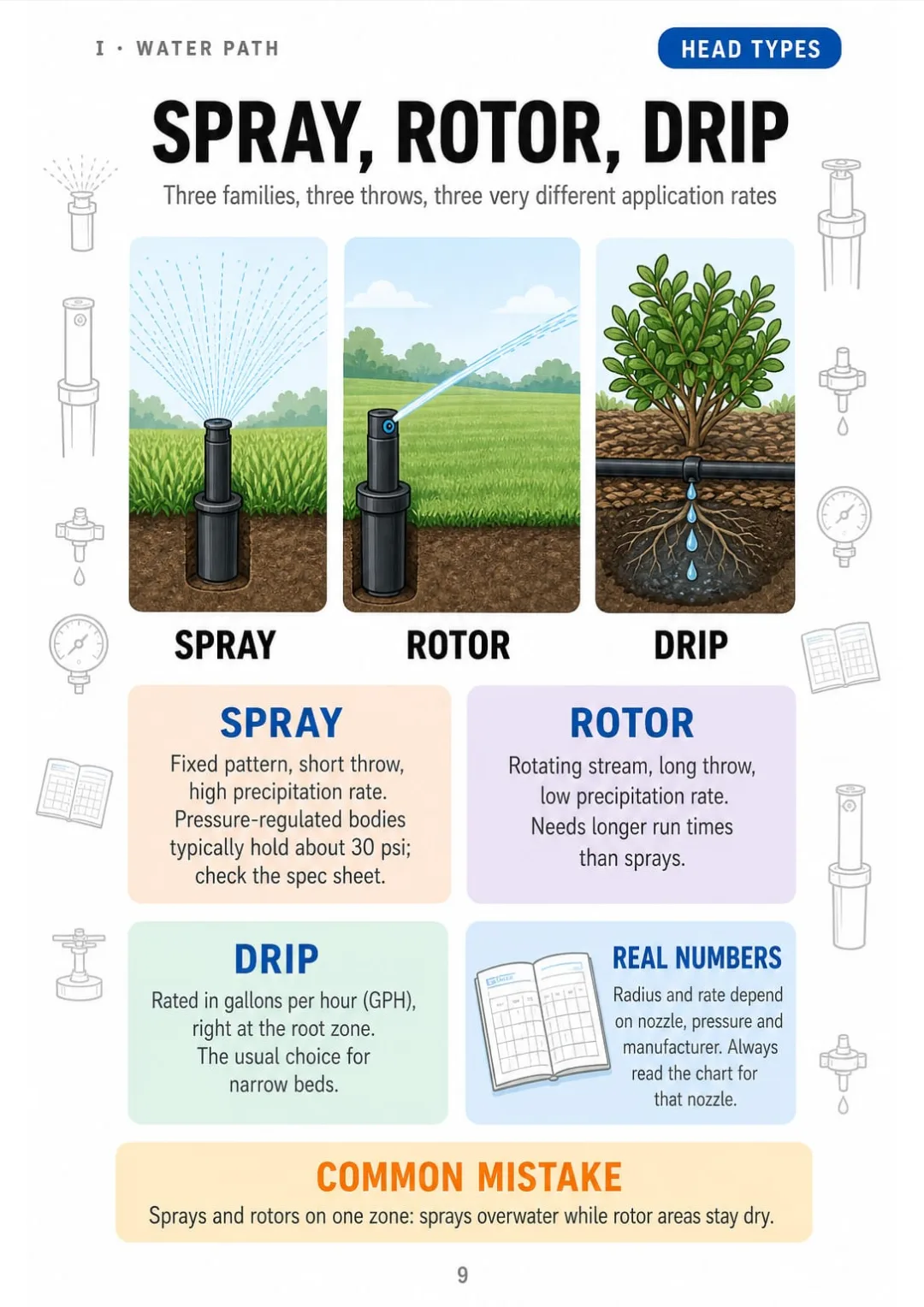
Sprays apply fast, rotors slow, drip in GPH at the roots: never mix on one zone.
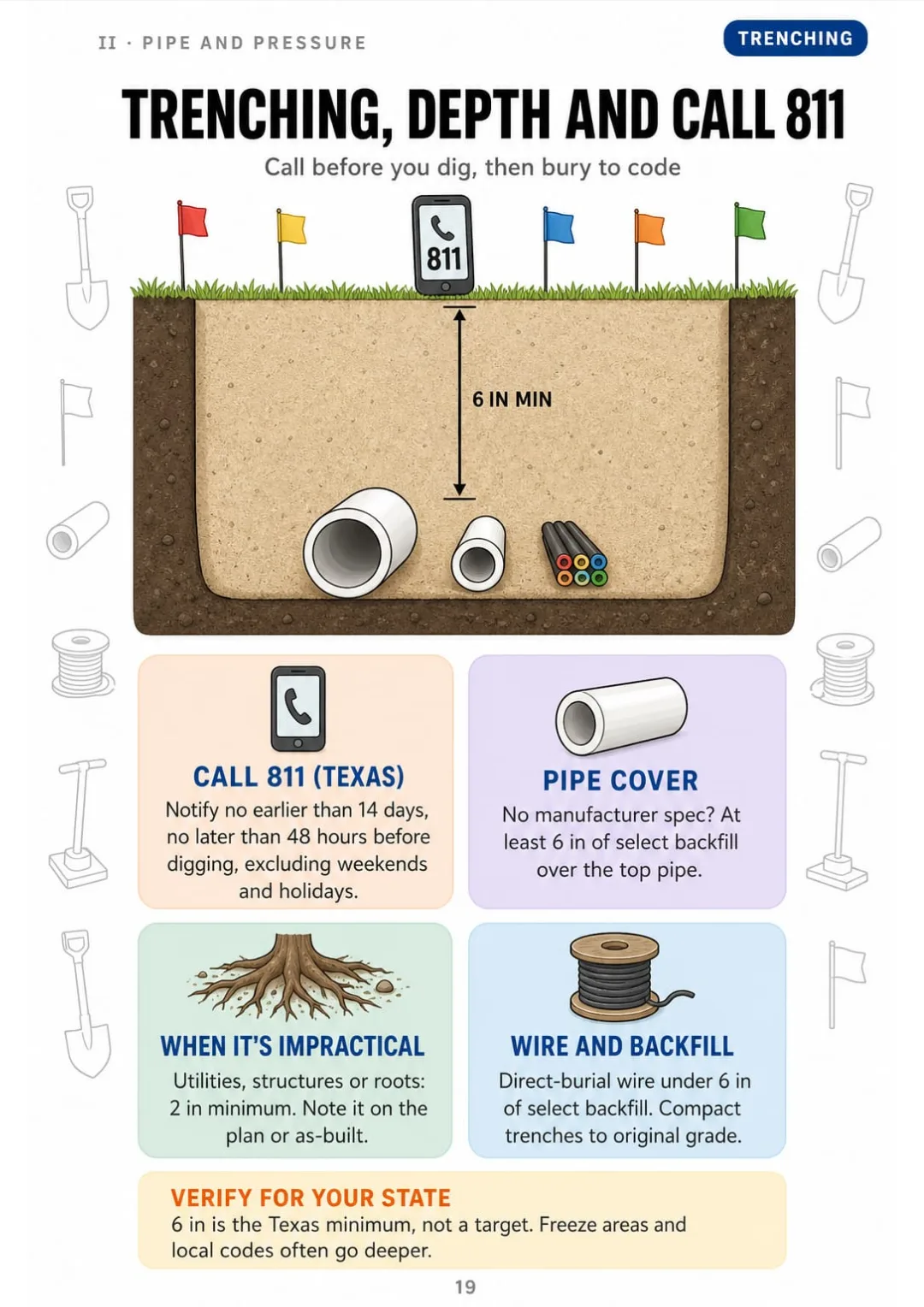
Texas 30 TAC 344: 6 in of select backfill over pipe; call 811 at least 48 hours ahead.
Head-to-head: spacing never wider than the published radius at real pressure.
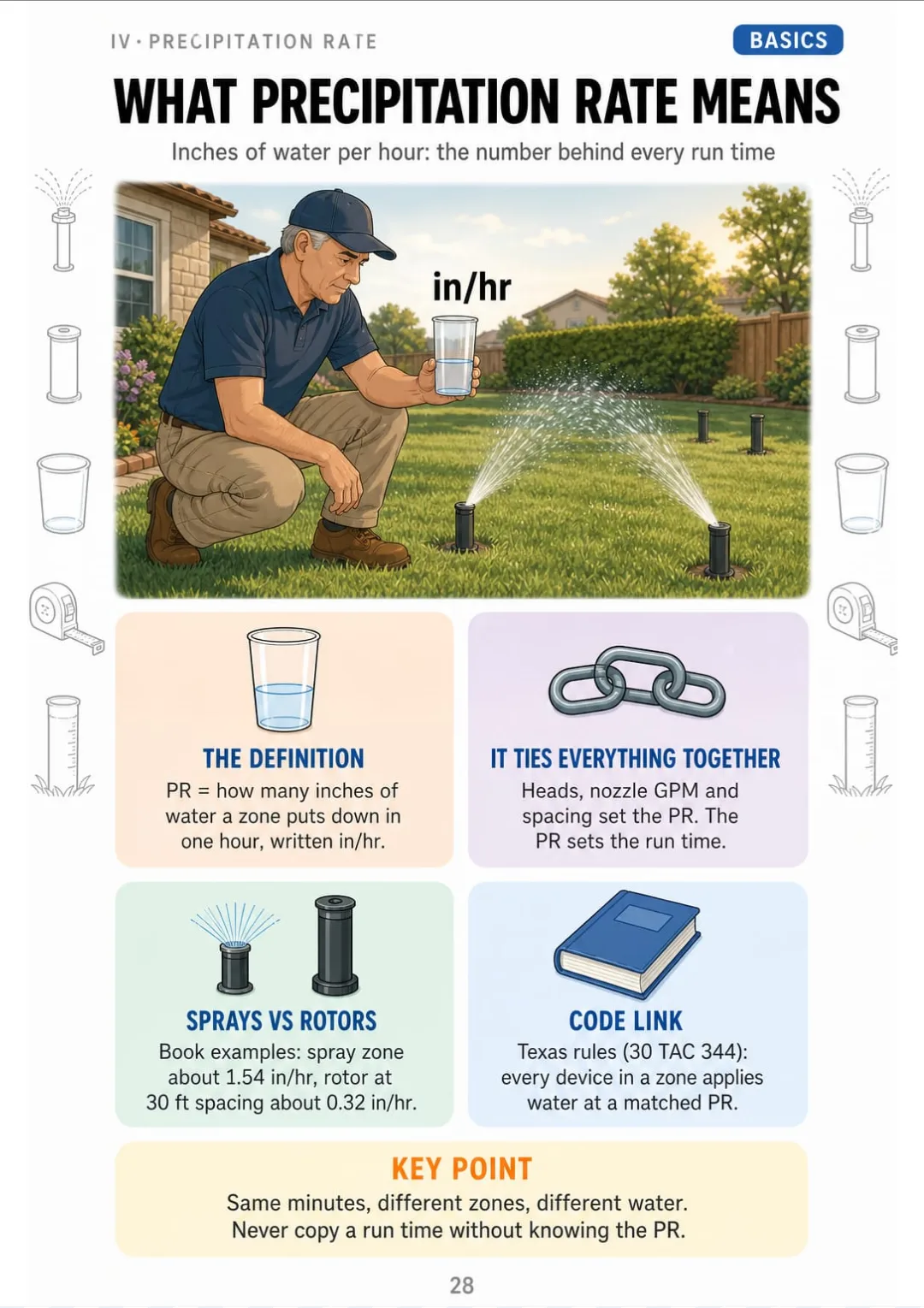
PR = inches of water per hour a zone applies (in/hr)
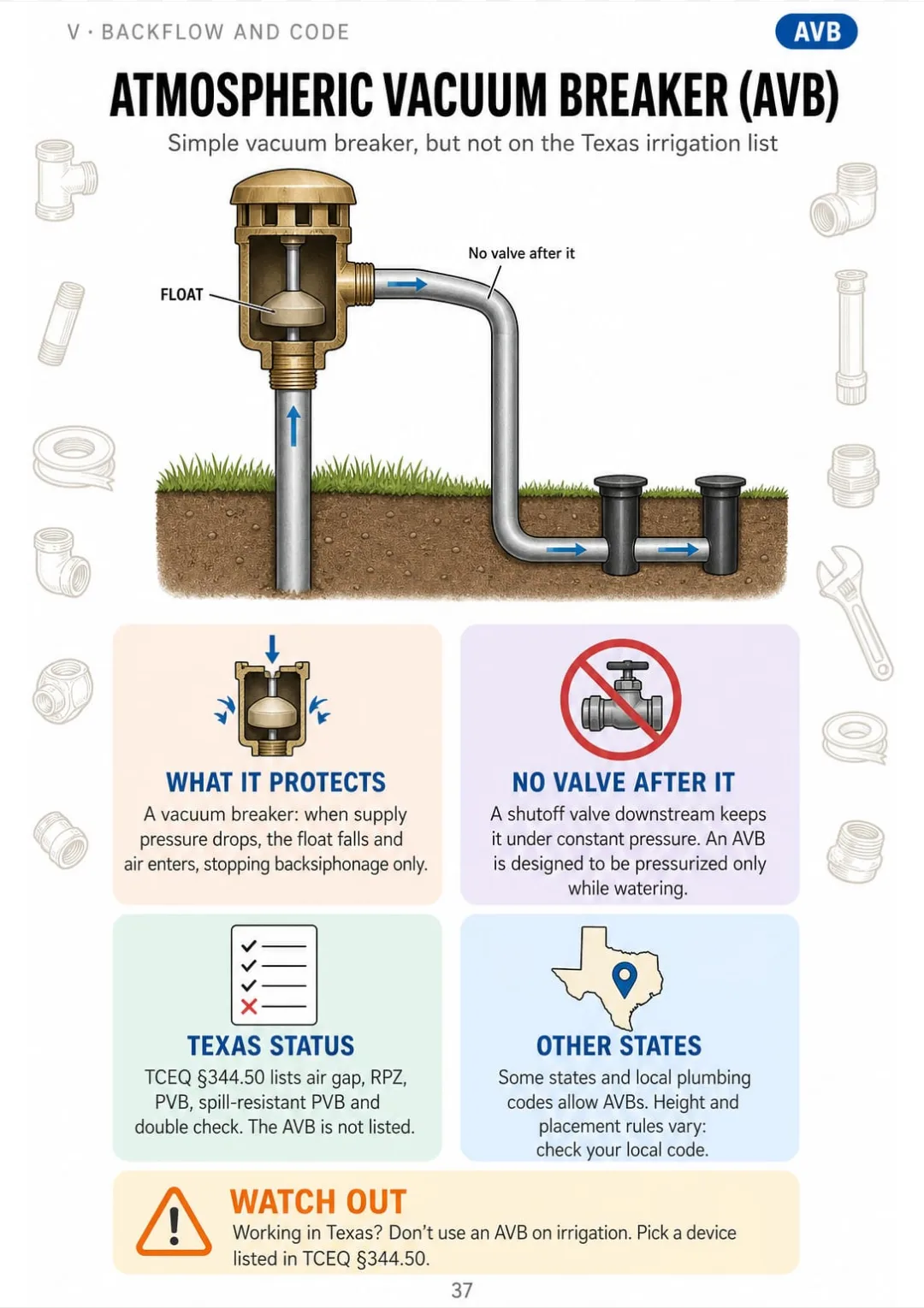
AVB: backsiphonage only, no valve downstream, not listed in TCEQ §344.50.
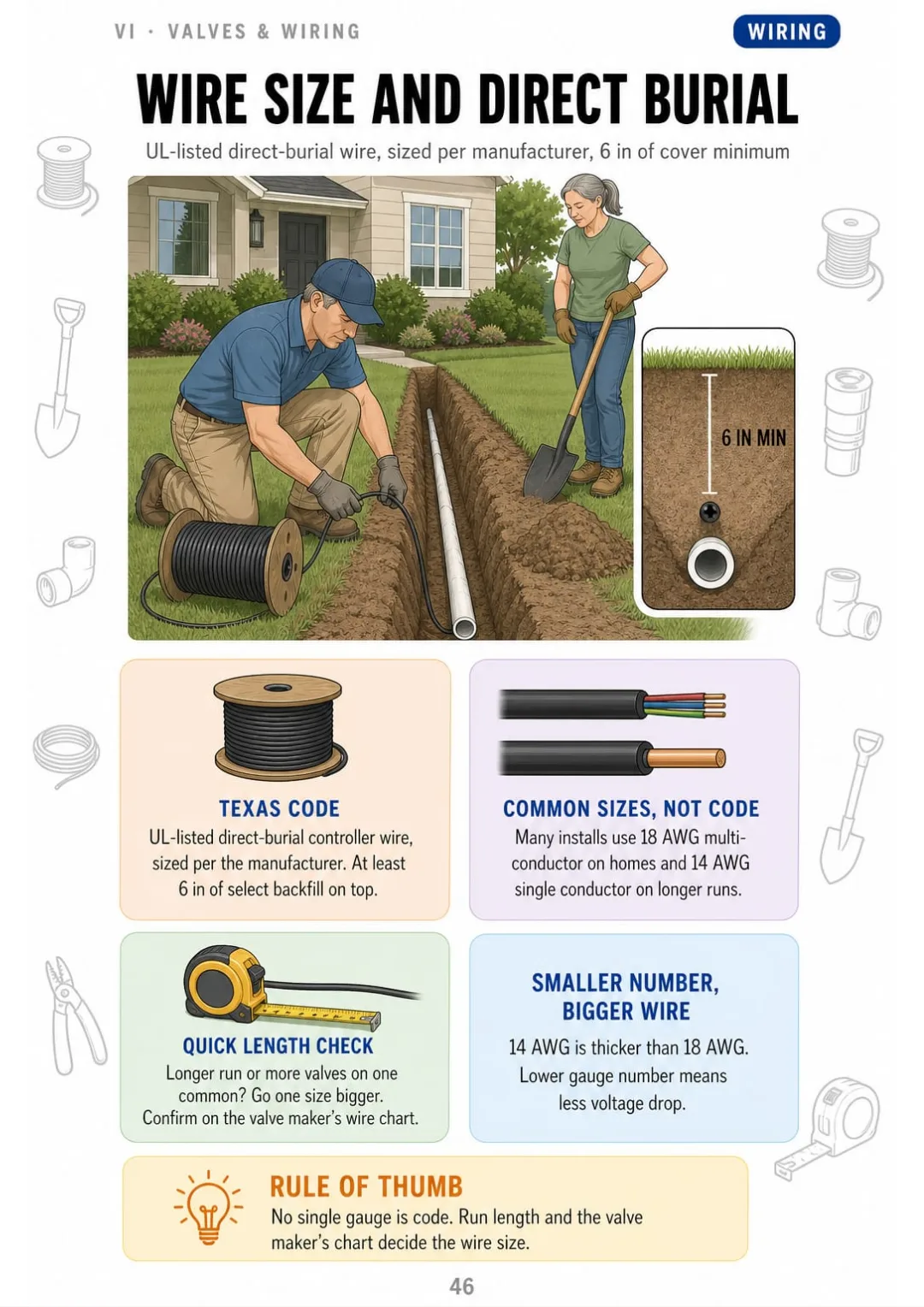
Texas §344.62(m): UL direct-burial wire, sized per manufacturer, 6 in of cover minimum.
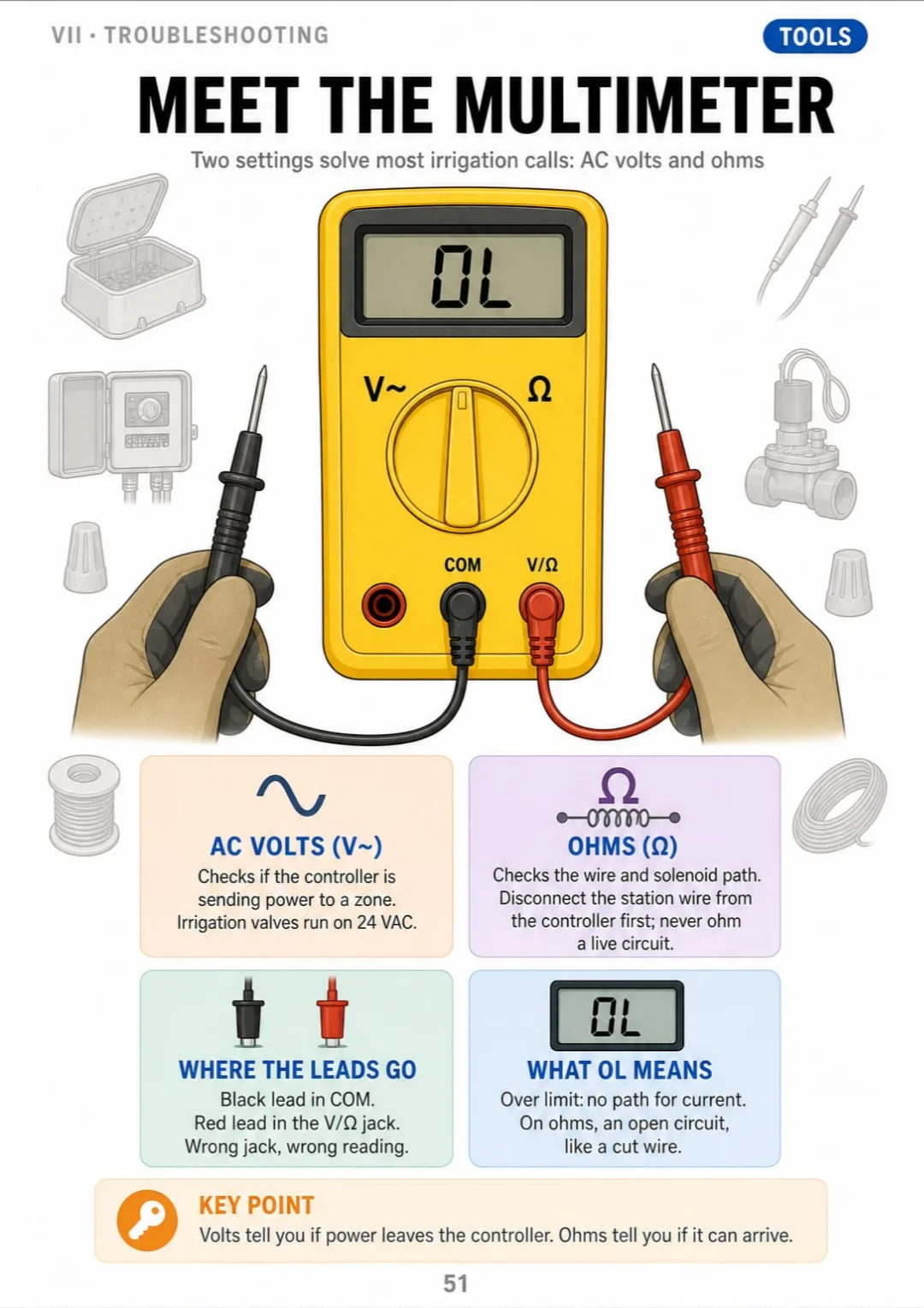
V~ and Ω: the two multimeter settings behind every irrigation diagnosis
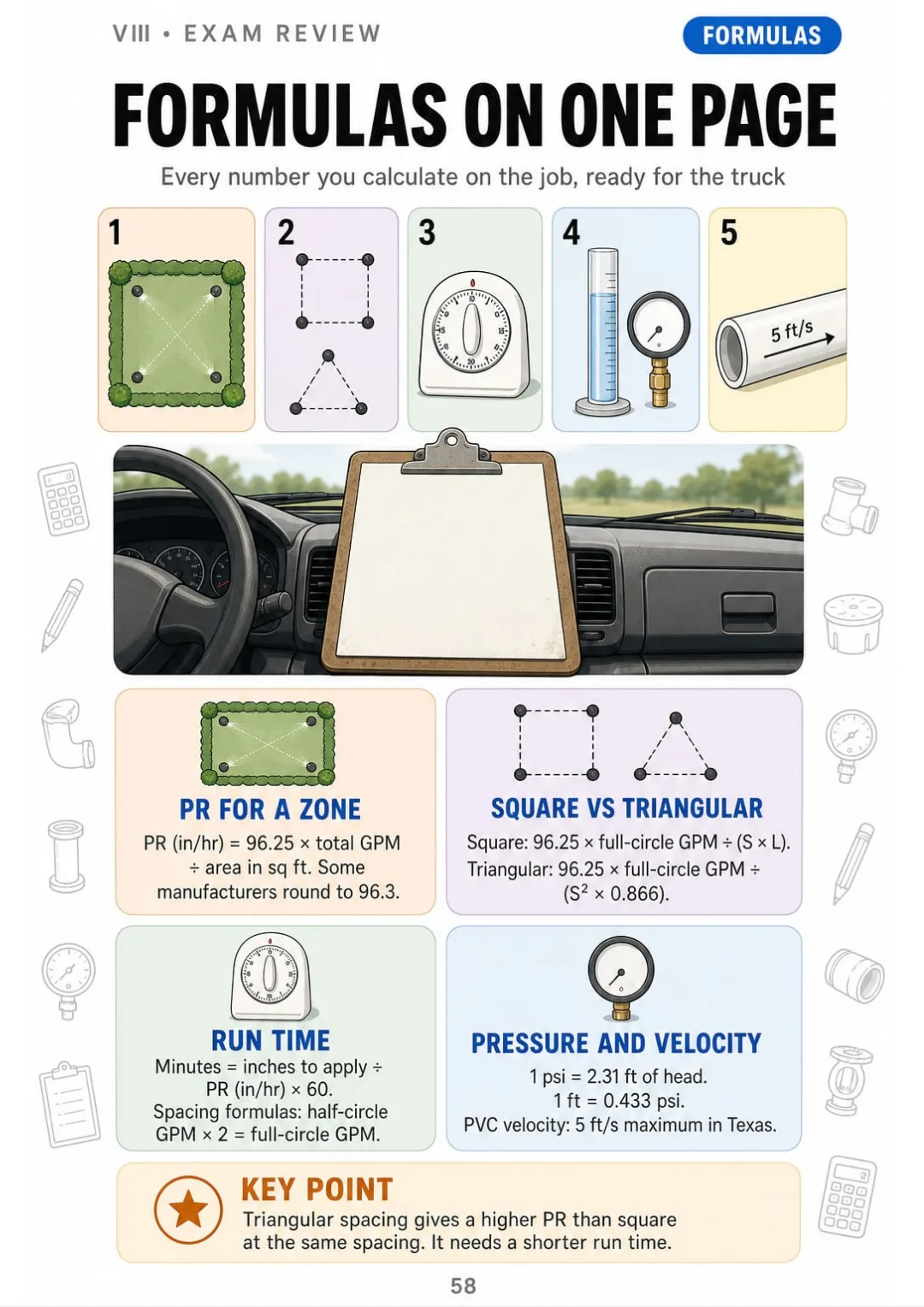
PR = 96.25 × GPM ÷ area · 1 psi = 2.31 ft · 5 ft/s in PVC

Swipe to see more →

These are real pages from the book. The table of contents is the full one: 8 parts and 59 topics.

The Problem Isn't You. It's How It Was Explained to You.

You're standing on a front lawn with a new zone flagged out, and the exam question is in your head: how far apart do these heads go?

Your hands know it: the water from one head reaches the next. But the manual spends three paragraphs on radius, published performance data and percentages, and by the second paragraph the picture is gone.

Head-to-head: spacing never wider than the published radius at real pressure.

In the book, head-to-head coverage is one page: each head's spray drawn reaching the next head, spacing set by the published radius at real operating pressure, and the Texas rule (30 TAC §344.62) in a box right beside it.

Static vs dynamic pressure, friction loss, precipitation rate, the backflow devices and the dead-zone check with a multimeter: each one has its own page too.

You see it, you get it, and you lay out the zone without going back to the manual.

COMPARE FOR YOURSELF

Same Topic, Two Ways to Study It

THIS
  • The manual: line after line after line
  • Static and dynamic pressure explained only in words
  • You walk into the exam still guessing
Static pressure is defined as the pressure exerted by water within a closed piping system when no flow is occurring, and is typically measured at or near the point of connection with all downstream valves in the closed position. Dynamic, or working, pressure refers to the pressure present at a given point in the system while water is flowing, and is invariably lower than static pressure as a consequence of friction losses in pipe, fittings, valves and meters, as well as changes in elevation between the source and the point of measurement.
FOR THIS
  • Static vs dynamic pressure in one drawing
  • The PSI numbers in a box
  • You see it and you get it
Texas 30 TAC 344: 6 in of select backfill over pipe; call 811 at least 48 hours ahead.
CONTENTS

Take a Look at the 8 Parts and 59 Topics

The path of the water, pipe and pressure, heads and coverage, precipitation and run time, backflow and code, valves and wiring, troubleshooting and the exam review: 63 pages, all illustrated.

IThe Path of the Water · pp. 5-11
  1. The Whole System on One Page
  2. Point of Connection: Where the System Starts
  3. Mainline vs Lateral Line
  4. What a Zone Is
  5. Spray, Rotor, Drip: Three Families
  6. Controller, Valves and Sensors at a Glance
  7. Licenses and Roles in Texas
IIPipe, Pressure and Friction · pp. 12-19
  1. Static vs Dynamic Pressure
  2. Feet of Head and PSI
  3. GPM: How Much Water You Have
  4. Friction Loss Explained
  5. Friction Loss: A Worked Example
  6. The 5 ft/s Velocity Rule
  7. PVC Schedule 40, Class 200, Poly
  8. Trenching, Depth and Call 811
IIIHeads and Coverage · pp. 20-27
  1. Head-to-Head Coverage
  2. Square vs Triangular Spacing
  3. Spray Heads and Nozzles
  4. Rotors and Matched Precipitation
  5. Operating Pressure by Head Type
  6. Pressure-Regulating Heads and Check Valves
  7. Narrow Areas and Hardscape
  8. Drip Zone Layout
IVPrecipitation Rate and Run Time · pp. 28-35
  1. What Precipitation Rate Means
  2. The 96.25 Constant
  3. PR for a Whole Zone: Worked Example
  4. PR for Square Spacing
  5. PR for Triangular Spacing
  6. Run Time from PR
  7. Cycle and Soak
  8. Catch-Cup Audit and Distribution Uniformity
VBackflow and Code · pp. 36-42
  1. Backflow: Backpressure vs Backsiphonage
  2. Atmospheric Vacuum Breaker (AVB)
  3. Pressure Vacuum Breaker (PVB)
  4. Double Check Valve Assembly (DCVA)
  5. Reduced Pressure Zone Assembly (RPZ)
  6. Choosing the Right Device
  7. Texas Code Must-Haves on Every Job
VIValves, Wiring and Controllers · pp. 43-50
  1. Inside a Solenoid Valve
  2. Manual Bleed and Flow Control
  3. Station Wire and Common Wire
  4. Wire Size and Direct Burial
  5. Waterproof Splices
  6. The Controller: Programs, Start Times, Run Times
  7. Rain, Freeze and Smart Controllers
  8. Master Valve and Pump Start
VIITroubleshooting Step by Step · pp. 51-57
  1. Meet the Multimeter
  2. Dead Zone: Step 1, Check the Controller Output
  3. Dead Zone: Step 2, Ohm the Circuit
  4. Dead Zone: Step 3, Test at the Valve
  5. Valve That Won't Shut Off
  6. Bad Common Wire
  7. Low Pressure and Poor Coverage
VIIIExam Review and Field Checklists · pp. 58-63
  1. Formulas on One Page
  2. Backflow Devices Side by Side
  3. Spring Startup in Order
  4. Winterization in Order
  5. Mistakes Most Often Seen on Installs
  6. Before the Exam: Last Review

One Page, One Topic, All Clear

Think of it this way:

It's the night before the exam, or a Tuesday on a job, and you need the precipitation rate of a zone: how many inches per hour is this zone putting down?

You open the book to that page and see the zone drawn, each head with its GPM, the area in square feet, and the 96.25 formula worked out with real numbers right next to it.

AVB: backsiphonage only, no valve downstream, not listed in TCEQ §344.50.

Same with static vs dynamic pressure, friction loss, head-to-head spacing, the four backflow devices and the dead-zone check: each one on its own page.

Irrigation Technician Illustrated is 8 parts and 59 topics, all drawn, and it ends with every formula on one page, the backflow devices side by side and a last review before the exam.

What you see drawn, you don't have to memorize.

What's Inside Irrigation Technician Illustrated:

Ipp. 5-11

The Path of the Water

The whole system on one page, the point of connection, mainline vs lateral, what a zone is, spray, rotor and drip, controller, valves and sensors, and licenses and roles in Texas.

IIpp. 12-19

Pipe, Pressure and Friction

Pressure you can actually picture: static vs dynamic, feet of head and PSI, GPM, friction loss with a worked example, the 5 ft/s rule, PVC and poly pipe, trench depth and calling 811.

IIIpp. 20-27

Heads and Coverage

Head-to-head coverage, square vs triangular spacing, spray nozzles, rotors and matched precipitation, operating pressure by head type, check valves, narrow areas and drip layout.

IVpp. 28-35

Precipitation Rate and Run Time

What precipitation rate means, the 96.25 constant, PR for a whole zone and for square and triangular spacing, run time, cycle and soak, and the catch-cup audit.

Vpp. 36-42

Backflow and Code

Pick the right backflow device and explain why: backpressure vs backsiphonage, AVB, PVB, double check and RPZ side by side, and the Texas code must-haves on every job.

VIpp. 43-50

Valves, Wiring and Controllers

Inside a solenoid valve, manual bleed and flow control, station and common wire, wire size and splices, controller programs, rain and freeze sensors, master valve and pump start.

VIIpp. 51-57

Troubleshooting Step by Step

Meet the multimeter, the dead zone in 3 steps, a valve that won't shut off, a bad common wire, and low pressure with poor coverage.

VIIIpp. 58-63

Exam Review and Field Checklists

Every formula on one page, backflow devices side by side, spring startup and winterization in order, the most frequent install mistakes and a last review.

At the end of the book: Every formula on one page, the four backflow devices side by side and a last review before the exam.


Plus: 2 Free Books

Irrigation Exam Practice: Questions with Answers Explained

BONUS 1: «Irrigation Exam Practice: Questions with Answers Explained»

Value on its own: US$ 17.90

Test yourself on coverage, precipitation math, pressure, wiring and backflow, and see why each answer is right before exam day.

The 15 Most Common Installation Mistakes, Before & After

BONUS 2: «The 15 Most Common Installation Mistakes, Before & After»

Value on its own: US$ 14.90

See each mistake drawn next to the right way to do it (mixed heads on one zone, missing head-to-head coverage, bad splices) so you spot them on the job and on the test.

Irrigation Technician Illustrated with 2 Free Books

  • Irrigation Technician Illustrated: 63 illustrated pagesUS$ 63
  • BONUS 1: Irrigation Exam Practice: Questions with Answers ExplainedUS$ 17.90
  • BONUS 2: The 15 Most Common Installation Mistakes, Before & AfterUS$ 14.90
  • High-resolution PDF to printIncluded
Total value US$ 95.80
YOUR PRICE:
US$ 27
You save US$ 68.80
YES, I WANT IRRIGATION TECHNICIAN ILLUSTRATED FOR US$ 27

📄 This is a digital PDF book sent to your email: nothing is printed or shipped.

Secure purchaseEncrypted payment30-day guarantee

PDF by email: We email you Irrigation Technician Illustrated as a PDF, together with the two free books. It's a single payment: no installments, no extra charges.

Who This Book Is For

You're studying for the license

You're studying for the license

You follow the water from the point of connection to the last head, one page per stop, so every part sits where it belongs in the system.

Your exam date is set

Your exam date is set

Formulas, pressure, backflow devices and wiring are each on one page, ready to review at a glance the week before.

You already run irrigation jobs

You already run irrigation jobs

You finally see the why behind what you do by hand, and you print the troubleshooting pages for the truck.

Everything You Get Today

US$ 95.80US$ 27
YES, I WANT IRRIGATION TECHNICIAN ILLUSTRATED FOR US$ 27

📄 This is a digital PDF book sent to your email: nothing is printed or shipped.

30DAYS
GUARANTEE

30-Day Guarantee

Try Irrigation Technician Illustrated for 30 days, bonus books included.

We refund everything if the file won't open, if the book isn't what you see here, if you were charged twice or if the email doesn't arrive. Just email us.

You pay once. No subscriptions.

Frequently Asked Questions

Is it for me if I've been installing irrigation for years and now want the license?

Yes. It's built for people who already do the work and want the why behind it: pressure, coverage, the math with worked examples, backflow and wiring. It's not beginner theory.

Where does the content come from?

From Texas rules: the TCEQ landscape irrigation rules (30 TAC Chapter 344) and Texas Occupations Code Chapter 1903, cross-checked with the Irrigation Association's technician exam content areas. Hydraulics, coverage, backflow and wiring work the same in every state; the code values are Texas values. If you test in another state, check them against your state's code.

Is this official material?

No. It's an independent illustrated study book. It isn't issued or endorsed by the TCEQ, the Irrigation Association or any state licensing board.

Does it replace the licensing course or training?

No. If your state requires an approved course or field experience, you still need it. The book doesn't give you a license, a certificate or CE hours: it helps you understand and review what you study there.

Are the practice questions the ones on the exam?

No. They're written for this book, in the style of the exam topics, to test yourself. They're not official exam questions.

When and how do I get it?

The book and the 2 bonus books arrive as a PDF by email, at the address you enter at checkout.

Do I have to pay every month?

No. It's a one-time payment. No subscription.

Can I have it on paper?

It's a PDF, not a shipped book. It prints on regular letter-size paper, so you can keep a copy in the truck, and it reads on your phone too.

How does the refund work?

You have 30 days. We refund everything if the file won't open, if the book isn't what you see on this page, if you were charged twice or if the email doesn't arrive: just email us.

Before You Close This Page

No more rereading the same chapter with nothing sticking.

Head-to-head spacing: you see it drawn, and that's it.

You walk into the exam knowing where everything is.

Drawings make studying faster.

The book is right below.

One-time payment: US$ 27 · Guarantee: 30 days · PDF by email

YES, I WANT IRRIGATION TECHNICIAN ILLUSTRATED FOR US$ 27

📄 This is a digital PDF book sent to your email: nothing is printed or shipped.